
Apicoectomy: Procedure, Recovery, Cost & Success Rate
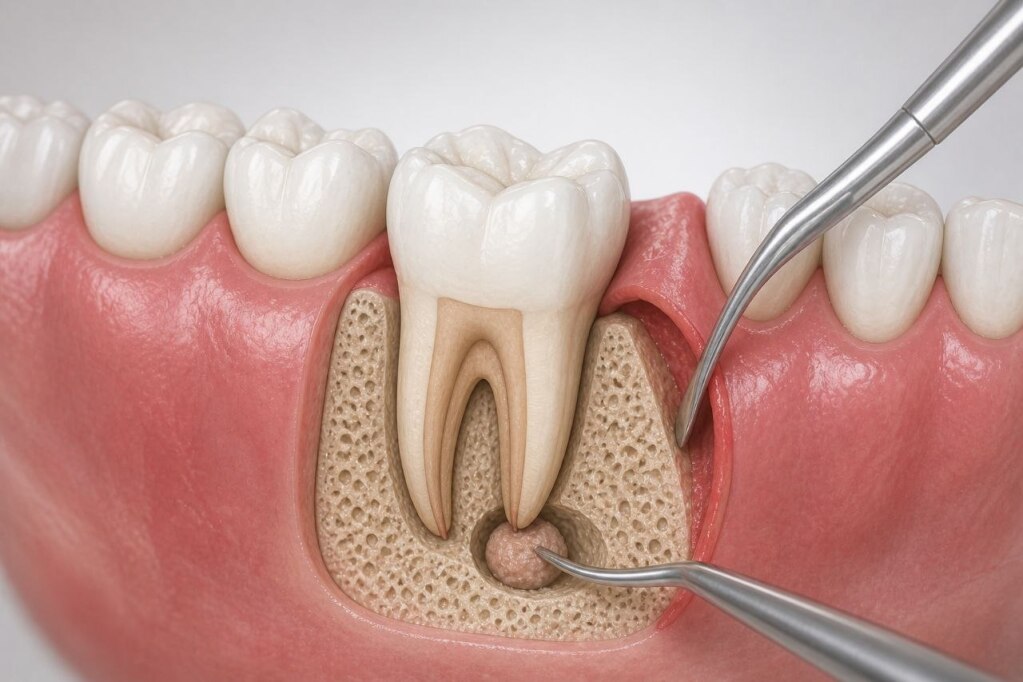
An apicoectomy is a minor surgical procedure performed to treat infection at the tip of a tooth’s root, typically after a failed root canal treatment.
Instead of removing the entire tooth, the procedure targets the infected area at the root end, preserving the natural tooth structure.
It is considered a last-line treatment to save a tooth when conventional endodontic therapy is no longer effective.
👉 In many cases, an apicoectomy can prevent the need for extraction and replacement.
What Is an Apicoectomy?
An apicoectomy, also known as root-end surgery, involves removing the tip (apex) of the tooth’s root along with infected tissue.
After removal, the end of the root is sealed to prevent further infection.
This procedure is typically performed by an endodontist, a specialist in treating the inner structures of teeth.
When Is an Apicoectomy Needed?
An apicoectomy is usually recommended when a previous root canal treatment has failed, and infection persists.
This may occur due to complex root anatomy, hidden canals, or incomplete healing.
Common indications include:
- Persistent infection after a root canal
- Presence of a cyst or abscess at the root tip
- Blocked or inaccessible root canals
- Failure of root canal retreatment
👉 It is often chosen when retreatment alone is not sufficient.
Apicoectomy vs Root Canal Retreatment
Both procedures aim to eliminate infection, but they differ in approach.
Root canal retreatment involves reopening the tooth and cleaning the canals again.
An apicoectomy, on the other hand, addresses the problem from the outside by surgically removing the infected root tip.
In some cases, retreatment is attempted first, with apicoectomy reserved for persistent problems.
The Apicoectomy Procedure
The procedure is typically performed under local anesthesia and is considered minimally invasive.
The dentist or endodontist makes a small incision in the gum to access the root tip.
The infected tissue and the end of the root are removed.
The root canal is then sealed with a biocompatible material to prevent reinfection.
Finally, the gum tissue is repositioned and sutured to allow healing.
👉 The focus is on removing infection while preserving as much of the natural tooth as possible.
Is an Apicoectomy Painful?
Thanks to modern anesthesia techniques, the procedure itself is not painful.
Patients may experience mild discomfort or swelling after the procedure, but this is usually manageable with medication.
Most people find it comparable to or less uncomfortable than a tooth extraction.
Recovery and Healing Time
Recovery after an apicoectomy is generally straightforward.
Mild swelling and discomfort may occur for a few days.
Most patients return to normal activities within a short period.
Initial healing occurs within one to two weeks, while complete bone healing may take several months.
👉 Following post-operative instructions is essential for optimal recovery.
Success Rate of Apicoectomy
Apicoectomy has a high success rate, often reported between 70% and 90%, depending on the case.
Success depends on factors such as the extent of infection, the quality of the procedure, and overall oral health.
With proper care, the treated tooth can function for many years.
Risks and Complications
Although generally safe, apicoectomy carries some risks.
These may include infection, swelling, or delayed healing.
In rare cases, nearby anatomical structures such as nerves may be affected.
👉 Choosing an experienced specialist significantly reduces these risks.
Alternatives to Apicoectomy
The main alternative is tooth extraction.
After extraction, the missing tooth can be replaced with options such as dental implants, bridges, or dentures.
However, preserving the natural tooth is usually the preferred option whenever possible.
Cost of an Apicoectomy
The cost varies depending on the tooth involved and the complexity of the procedure.
The average range price goes around: $900 – $1,500 per tooth.
Front teeth are generally less expensive to treat than molars.
Insurance may cover part of the cost if the procedure is considered medically necessary.
How to Care After an Apicoectomy
Post-operative care is essential for proper healing.
Patients are usually advised to maintain good oral hygiene while avoiding the surgical area initially.
A soft diet may be recommended for a few days.
Follow-up visits help ensure the area is healing correctly.
Clinical Insight
Apicoectomy reflects a key principle in dentistry: preserving natural teeth whenever possible, even in complex cases.
👉 Surgical intervention at the root level can often extend the life of a tooth that would otherwise be lost.
When to See a Dentist
You should seek evaluation if:
- You have persistent symptoms after a root canal
- You experience recurring infection or swelling
- You are advised that retreatment may not be sufficient
Early assessment improves the chances of successful treatment.
Conclusion
An apicoectomy is an effective surgical procedure used to treat persistent infection at the root tip of a tooth.
It offers a way to preserve the natural tooth when standard treatments are not enough.
The key points are clear:
- It removes infected tissue at the root tip
- It is often performed after failed root canal treatment
- It has a high success rate when properly indicated
👉 In many cases, an apicoectomy can save a tooth and avoid extraction.
Frequently Asked Questions
How long does an apicoectomy take?
The procedure usually takes 30 to 90 minutes, depending on complexity.
Is it better than extraction?
Saving the natural tooth is generally preferred when possible.
How long does it take to heal?
Initial healing takes one to two weeks, with full healing over several months.
Can the infection come back?
It is possible, but success rates are high with proper treatment.
Will I need a crown afterward?
It depends on the condition of the tooth and previous restorations.
References
Kim, S., & Kratchman, S. (2006). Modern endodontic surgery concepts and practice. Journal of Endodontics, 32(7), 601–623.
Setzer, F. C., Shah, S. B., Kohli, M. R., Karabucak, B., & Kim, S. (2010). Outcome of endodontic surgery: A meta-analysis. Journal of Endodontics, 36(11), 1757–1765.
Tsesis, I., Rosen, E., Schwartz-Arad, D., & Fuss, Z. (2006). Retrospective evaluation of surgical endodontic treatment. Journal of Endodontics, 32(8), 736–740.