
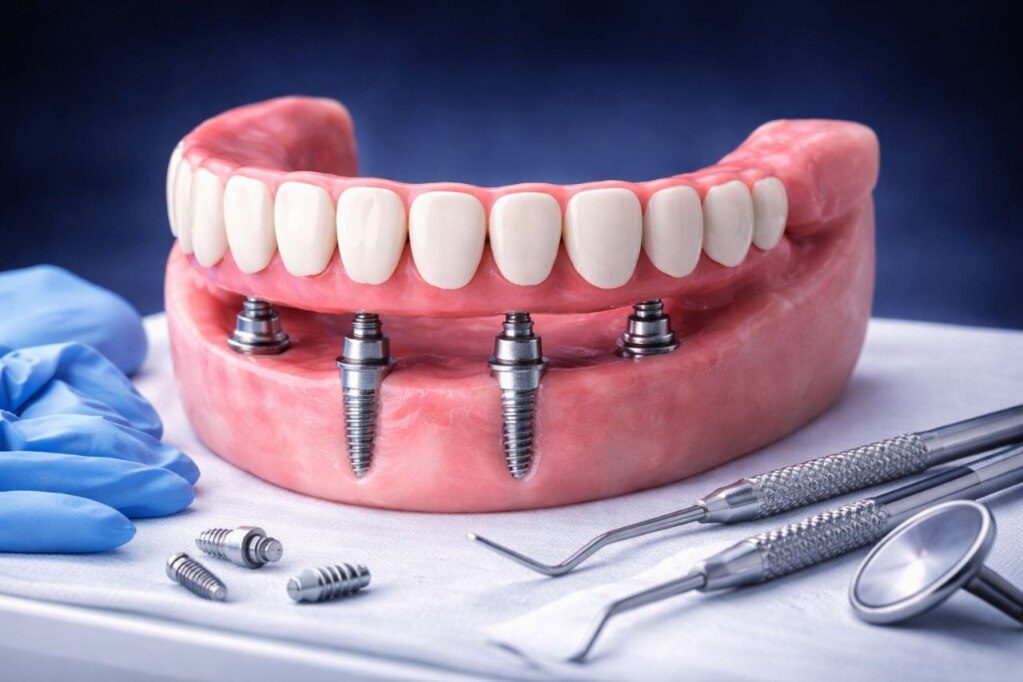
Fixed Full-Arch Implants: Cost, Procedure, Types & Benefits
Fixed full-arch implants are a permanent solution for replacing an entire set of teeth using dental implants that support a non-removable prosthesis.
Unlike removable dentures, this approach restores full function, stability, and aesthetics, closely mimicking natural teeth.
It is commonly used in full-mouth rehabilitation and is considered one of the most advanced restorative options in modern dentistry.
This is the closest thing to getting your natural teeth back.
What Are Fixed Full-Arch Implants?
Fixed full-arch implants involve placing multiple traditional dental implants into the jawbone to support a full arch of prosthetic teeth.
The prosthesis is securely attached and cannot be removed by the patient.
This provides superior stability compared to removable alternatives.
How They Differ from All-on-4 Implants
While both are fixed solutions, they are not the same.
All-on-4 implants are a specific technique that uses exactly four implants in a standardized configuration.
Fixed full-arch implants, on the other hand, are a broader category and may use 4, 6, 8, or more implants, depending on the case.
All-on-4 is one type of fixed full-arch implant, but not the only one.
Types of Fixed Full-Arch Implant Systems
Different configurations can be used depending on bone availability and treatment goals.
🔹4-Implant Systems: Often used in cases with limited bone, similar to All-on-4 concepts.
🔹6-Implant Systems: Provide greater stability and load distribution, especially in patients with adequate bone.
🔹8+ Implant Systems: Used in highly demanding cases for maximum support and durability.
👉 More implants generally mean better force distribution and long-term stability.
Who is a Candidate?
Fixed full-arch implants are ideal for patients who:
- Have lost most or all of their teeth
- Have failing or severely damaged teeth
- Want a permanent, non-removable solution
- Are dissatisfied with traditional dentures
Patients with bone loss may still qualify with additional procedures or alternative techniques.
The Procedure Step by Step
- Treatment begins with a comprehensive evaluation, including imaging to assess bone structure and plan implant placement.
- Any remaining damaged teeth may be extracted.
- Implants are then surgically placed into the jawbone.
- In some cases, a temporary prosthesis is attached on the same day.
- After healing and osseointegration, a permanent prosthesis is placed.
💠 Precision in planning and execution is critical for success.
Healing and Recovery
- Initial recovery typically takes one to two weeks.
- Full integration of the implants with the bone can take 3 to 6 months.
- Patients may need to follow a soft diet during early healing.
Cost of Fixed Full-Arch Implants
In the United States, costs typically range from:
- $25,000 – $50,000 per arch
- $50,000 – $100,000+ for full mouth
Costs vary depending on the number of implants, materials, and complexity of the case. More implants and premium materials (like zirconia) increase the total cost.
Benefits of Fixed Full-Arch Implants
This treatment offers several major advantages:
- It provides a permanent solution that does not move or slip.
- It restores full chewing function and improves diet and nutrition.
- It helps preserve jawbone structure and facial appearance.
- It offers superior comfort compared to removable dentures.
💠 Stability is the biggest advantage.
Fixed Full-Arch Implants vs Implant-Supported Dentures
Implant-supported dentures may be removable or semi-fixed.
Fixed full-arch implants are completely non-removable and provide greater stability. They also offer a more natural feel and function.
Fixed solutions are typically preferred when possible.
Fixed Full-Arch Implants vs Dentures
Traditional dentures rest on the gums and can become unstable over time.
Fixed full-arch implants are anchored in bone, eliminating movement and improving performance. They also reduce bone loss, which is common with long-term denture use.
Risks and Complications
As with any surgical procedure, there are potential risks. These include:
- Infection.
- Implant failure.
- Complications during healing.
Risk factors such as smoking or poor oral hygiene can affect outcomes. Proper care and follow-up are essential.
How Long Do Fixed Full-Arch Implants Last?
With proper care, implants can last for decades. The prosthesis may require maintenance or replacement over time due to wear.
Clinical Insight: Fixed full-arch implants demonstrate how biomechanics and implant distribution affect long-term success.
Increasing the number of implants improves load distribution and reduces stress on each implant.
When to See a Specialist
You should consider evaluation if:
- You have multiple missing or failing teeth
- You want a permanent alternative to dentures
- You are considering full mouth dental implants
Early consultation allows for better planning and predictable outcomes.
Conclusion
Fixed full-arch implants are a highly advanced dental treatment for replacing an entire set of teeth with a permanent, stable prosthesis.
They offer superior function, durability, and aesthetics compared to removable options.
The key points are clear:
- They provide a non-removable full-arch solution
- They may use 4 to 8 or more implants
- They include techniques like All-on-4 implants
When properly planned, they deliver long-term results and significantly improve quality of life.
Frequently Asked Questions
Are fixed full-arch implants permanent?
They are designed to be long-lasting, though maintenance may be needed.
How many implants are required?
Typically between 4 and 8 per arch, depending on the case.
Are they better than dentures?
They provide greater stability, function, and comfort.
Is the procedure painful?
No, it is performed under anesthesia, with manageable discomfort afterward.
How long does treatment take?
Several months, including healing and integration time.
References
Misch, C. E. (2008). Contemporary implant dentistry (3rd ed.). Mosby Elsevier.
Esposito, M., Grusovin, M. G., Felice, P., & Karatzopoulos, G. (2010). Interventions for replacing missing teeth. Cochrane Database of Systematic Reviews, (3), CD003607.
Brånemark, P. I. (1983). Osseointegration and its experimental background. Journal of Prosthetic Dentistry, 50(3), 399–410.