
As an Amazon affiliate, I earn a commission for the products linked below.
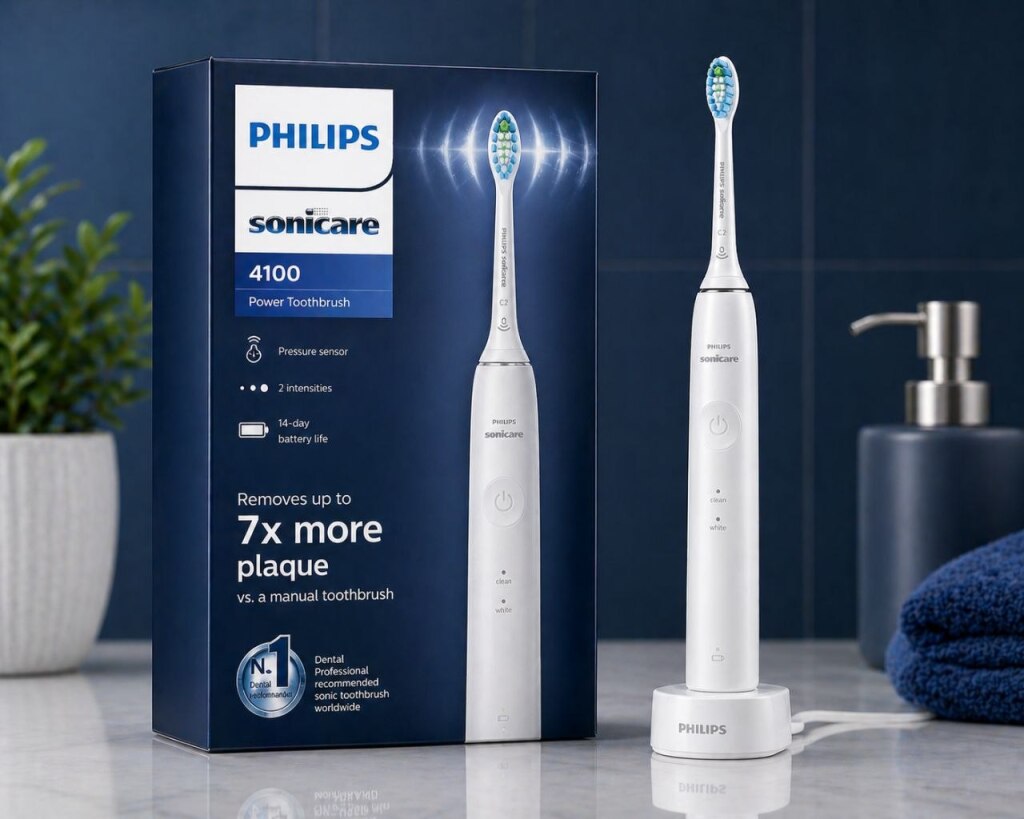
Philips Sonicare 4100 Review: Is This Budget Sonic Toothbrush Worth It?
If you’re considering an affordable sonic toothbrush, the Philips Sonicare 4100 is often one of the first models that comes up.
It promises gentle sonic cleaning, a pressure sensor, two intensity settings, and a long battery life, without moving into premium pricing.
That sounds compelling.
But does it actually perform well enough to justify choosing it over a manual toothbrush, or even an entry-level Oral-B?
In this review, we’ll look at what the Philips Sonicare 4100 does well, where it falls short, and whether it’s worth buying.
Quick Verdict
Our Take: Yes, for many people, this is one of the best budget sonic toothbrushes available.
It keeps the essentials. Skips the gimmicks. And focuses on what matters.
Best For:
✔ First-time electric toothbrush users
✔ People with sensitive gums
✔ Those who prefer sonic brushing
✔ Users prone to brushing too hard
✔ Buyers looking for value
✅ Pros:
- Gentle but effective plaque removal
- Built-in pressure sensor
- Two intensity settings
- Long battery life
- Lightweight ergonomic handle
- Good value for the price
❌ Cons:
- Only one cleaning mode
- No travel case
- Fewer features than higher-end Sonicare models
- Some users report durability concerns over time
What Makes the Philips Sonicare 4100 Different?
The biggest difference is the brushing technology.
Unlike oscillating brushes that rotate, the Philips Sonicare 4100 uses high-frequency sonic vibrations.
That helps move fluid between teeth and along the gumline while bristles clean tooth surfaces.
Key Features
- Sonic cleaning technology
- Up to 31,000 brush strokes per minute
- Pressure sensor
- Two intensity settings
- 2-minute Smart-timer
- QuadPacer
- Up to 14-day battery life
Simple feature set. But well chosen.
Cleaning Performance
Cleaning performance is very good. Especially for this price tier.
Philips states up to 5–7x better plaque removal versus manual brushing, depending on variant and claim source.
Marketing claims aside… Real-world users often like the clean feel and gumline performance.
What It Does Well:
✅ Gentle plaque removal
✅ Good gumline cleaning
✅ Comfortable brushing feel
✅ May suit sensitive mouths well
And this matters: Some people simply prefer sonic brushing over rotating brush heads. That preference is real.
The Pressure Sensor Is More Useful Than It Sounds
This is not filler. The pressure sensor can warn you if you’re brushing too hard and reduce the damaging force.
That matters for:
- Gum recession concerns
- Tooth sensitivity
- Enamel preservation
For many people, that alone adds value.
Battery Life
Battery life is one of its stronger points. Expect up to 14 days per charge
That’s better than many entry-level brushes and useful for travel.
Potential Drawbacks
🔸 It’s Basic
This is not a feature-rich brush. You do not get multiple cleaning modes, app connectivity, or premium feedback tools. For some people, that’s fine.
🔸 Durability Concerns Exist
Some users report charging or longevity issues over time. Not universal. But worth noting.
🔸 Intensity Settings May Frustrate Some Users
Some users report quirks with default intensity behavior. It’s a minor issue, but it’s real.
Philips Sonicare 4100 vs Competitors
💠 Philips Sonicare 4100 vs Oral-B Pro 1000
Choose Sonicare 4100 if you want:
- Gentler brushing feel
- Quieter operation
- Better battery life
Choose Oral-B Pro 1000 if you want:
- Stronger mechanical plaque-focused cleaning
- Smaller brush head
- Lower-cost replacement heads (often)
This often comes down to a preference for sonic vs. oscillating.
💠 Philips Sonicare 4100 vs Oral-B Smart 1500
Choose Sonicare 4100 if you want:
- Gentler feel
- Simplicity
- Lower price
Choose Oral-B Smart 1500 if you want:
- More brushing feedback
- Stronger pressure-control features
- More modes
Who Should Buy It?
The Philips Sonicare 4100 may be worth buying if you:
- Want a simple sonic toothbrush
- Have mild gum sensitivity
- Prefer gentle brushing
- Want long battery life
- Want strong value without extra features
Who Should Skip It?
You may want another option if you:
- Want multiple cleaning modes
- Prefer rotating brush heads
- Want app features
- Need a premium travel case
- Want the quietest or most advanced Sonicare model
Frequently Asked Questions
Is Philips Sonicare 4100 good for receding gums?
It may be a good option, particularly because sonic brushing can feel gentler and the pressure sensor can discourage overbrushing. Technique still matters.
Is Sonicare 4100 good for sensitive teeth?
Yes. Many people choose it specifically for that reason.
Is Philips Sonicare 4100 better than Oral-B Pro 1000?
Not universally better. Just different. It often comes down to brushing preference.
How long do Sonicare 4100 brush heads last?
Typically about 3 months, or less if bristles fray.
Final Verdict: Is The Sonicare 4100 Worth It?
Yes — for many people, absolutely.
The Philips Sonicare 4100 does not try to be fancy. It tries to be effective. And it largely succeeds.
If you want a gentle, simple, well-priced sonic toothbrush with pressure protection and strong battery life, it’s a very solid option.