
Dental Bone Graft: Procedure, Cost, Healing & Recovery
A dental bone graft is a procedure used to rebuild or replace bone in the jaw that has been lost due to tooth loss, gum disease, or trauma.
It is commonly performed to prepare the jaw for dental implants, ensuring there is enough bone to support them securely.
Without sufficient bone, implants cannot integrate properly, making this procedure essential in many advanced dental treatments.
👉 It is one of the most important techniques in modern implant dentistry.
What Is a Dental Bone Graft?
A dental bone graft involves placing bone material into an area of the jaw where bone is missing or insufficient.
This material acts as a scaffold, allowing new bone to grow and regenerate over time.
The process is part of what is known clinically as bone augmentation surgery, which focuses on increasing bone volume and density.
Why Is a Dental Bone Graft Needed?
Bone loss in the jaw can occur for several reasons:
- When a tooth is lost, the surrounding bone begins to shrink due to a lack of stimulation.
- Periodontal disease can also destroy bone over time, weakening the structure that supports teeth.
- In some cases, natural anatomy may not provide enough bone for implant placement.
👉 A bone graft restores the foundation needed for long-term oral health and implant success.
Dental Bone Graft for Implants
Dental implants require a stable and sufficient amount of bone to anchor properly.
If the jawbone is too thin or weak, a bone graft may be necessary before implant placement.
In some situations, the graft and implant can be placed simultaneously.
In others, a healing period is required before proceeding with the implant.
Types of Dental Bone Grafts
Different types of graft materials can be used depending on the case.
💠 Autograft
This involves using bone taken from the patient’s own body, often from another area of the jaw. It is considered highly effective due to its compatibility and ability to promote bone growth.
💠 Allograft
Bone material obtained from a donor source and processed for safe use. It eliminates the need for a second surgical site.
💠 Xenograft
Bone derived from animal sources, commonly bovine. It provides a natural structure that supports new bone formation.
💠 Synthetic Graft
Man-made materials designed to mimic natural bone. These are increasingly used due to their availability and effectiveness.
👉 The choice depends on clinical needs and patient factors.
The Procedure Step by Step
- The procedure is typically performed under local anesthesia.
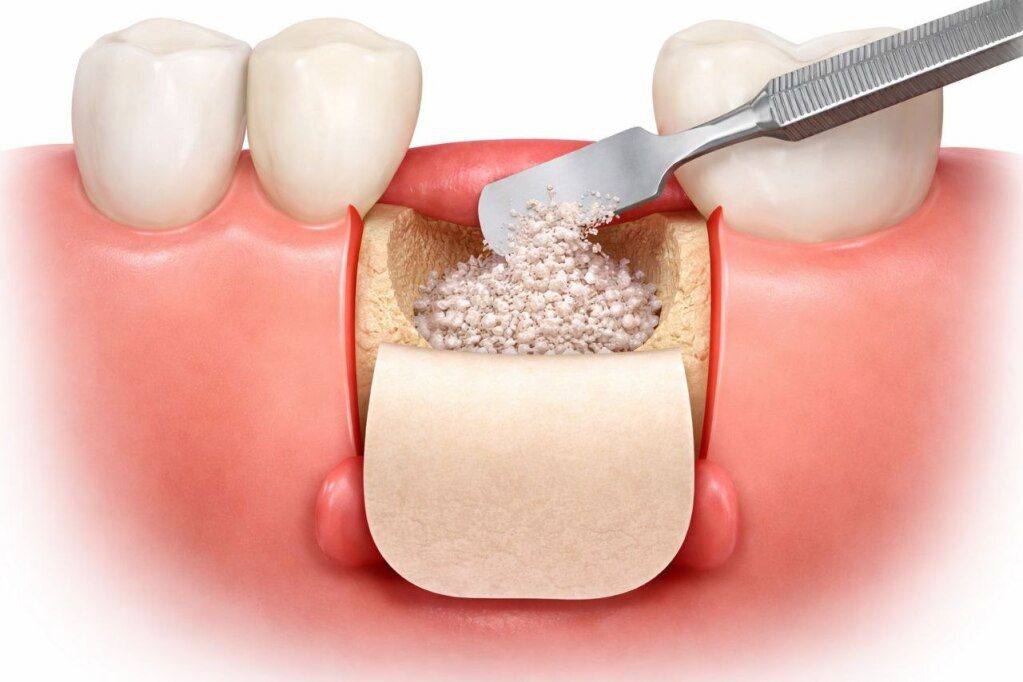
- The dentist or surgeon prepares the area and places the bone graft material in the targeted site.
- A membrane may be used to protect the graft and support healing.
- The gum tissue is then closed over the area to allow integration.
👉 The goal is to create a stable environment for new bone growth.
Is a Dental Bone Graft Painful?
The procedure itself is not painful due to anesthesia.
Afterward, patients may experience mild discomfort, swelling, or soreness in the treated area.
These symptoms are usually manageable and temporary.
Healing Time and Bone Regeneration
Healing after a dental bone graft is a gradual process.
Initial healing of the soft tissues occurs within one to two weeks.
However, full bone regeneration can take 3 to 6 months, or longer, depending on the case.
👉 This healing period is essential for long-term success.
Risks and Complications
Dental bone grafting is generally safe, but it carries potential risks.
These may include infection, graft failure, or delayed healing.
In rare cases, the graft may not integrate properly with the existing bone.
👉 Careful planning and proper post-operative care minimize these risks.
Cost of a Dental Bone Graft
The cost varies depending on the size of the graft, materials used, and complexity of the procedure.
Average Bone Graft Price:
- Minor bone graft: $300 – $800.
- Moderate bone graft: $800 – $2,500. (Typical implant prep).
- Major/Complex graft: $2,500 – $5,000.
It is often an additional cost on top of dental implant treatment.
Insurance coverage may apply if the procedure is considered medically necessary.
Benefits of Dental Bone Grafting
The main benefit is restoring the jaw’s structural integrity.
It enables the successful placement of dental implants and improves long-term oral function.
It can also help maintain facial structure by preventing bone loss progression.
Who Is a Good Candidate?
Candidates include individuals with insufficient jawbone for implants or those experiencing bone loss due to disease or injury.
They should be in good general health and committed to maintaining proper oral hygiene.
A thorough evaluation is necessary to determine suitability.
Clinical Insight
Dental bone grafting highlights the principle that bone is a dynamic tissue that responds to stimulation and regeneration.
Rebuilding bone is often the key step that makes advanced treatments like implants possible.
When to See a Dentist or Specialist
You should seek evaluation if:
- You are considering dental implants
- You have missing teeth and bone loss
- You have been told you lack sufficient jawbone
Early intervention allows for more predictable outcomes.
Conclusion
A dental bone graft is a fundamental procedure for restoring lost bone in the jaw and enabling successful dental treatments.
It plays a crucial role in implant dentistry and long-term oral health.
The key points are clear:
- It rebuilds bone lost due to disease or tooth loss
- It is often required before dental implants
- It supports long-term function and stability
👉 In many cases, it is the step that enables advanced dental restoration.
Frequently Asked Questions
How long does a dental bone graft take?
The procedure usually takes 45 to 90 minutes, depending on complexity.
Is a bone graft always needed before implants?
Not always, but it is required when there is insufficient bone.
Can a bone graft fail?
Yes, but failure is uncommon with proper technique and care.
How long before I can get implants?
Typically, 3 to 6 months after the graft, depending on healing.
Is the procedure safe?
Yes, when performed by a qualified professional.
References
Aghaloo, T. L., & Moy, P. K. (2007). Which hard tissue augmentation techniques are the most successful in furnishing bony support for implant placement? International Journal of Oral and Maxillofacial Implants, 22(Suppl), 49–70.
Esposito, M., Grusovin, M. G., Felice, P., & Karatzopoulos, G. (2010). Interventions for replacing missing teeth: Bone augmentation techniques. Cochrane Database of Systematic Reviews, (3), CD003607.
Misch, C. E. (2008). Contemporary implant dentistry (3rd ed.). Mosby Elsevier.