
Dental Implants: Procedure, Types, Cost, Healing & Risks
Dental implants are the most advanced and reliable solution for replacing missing teeth.
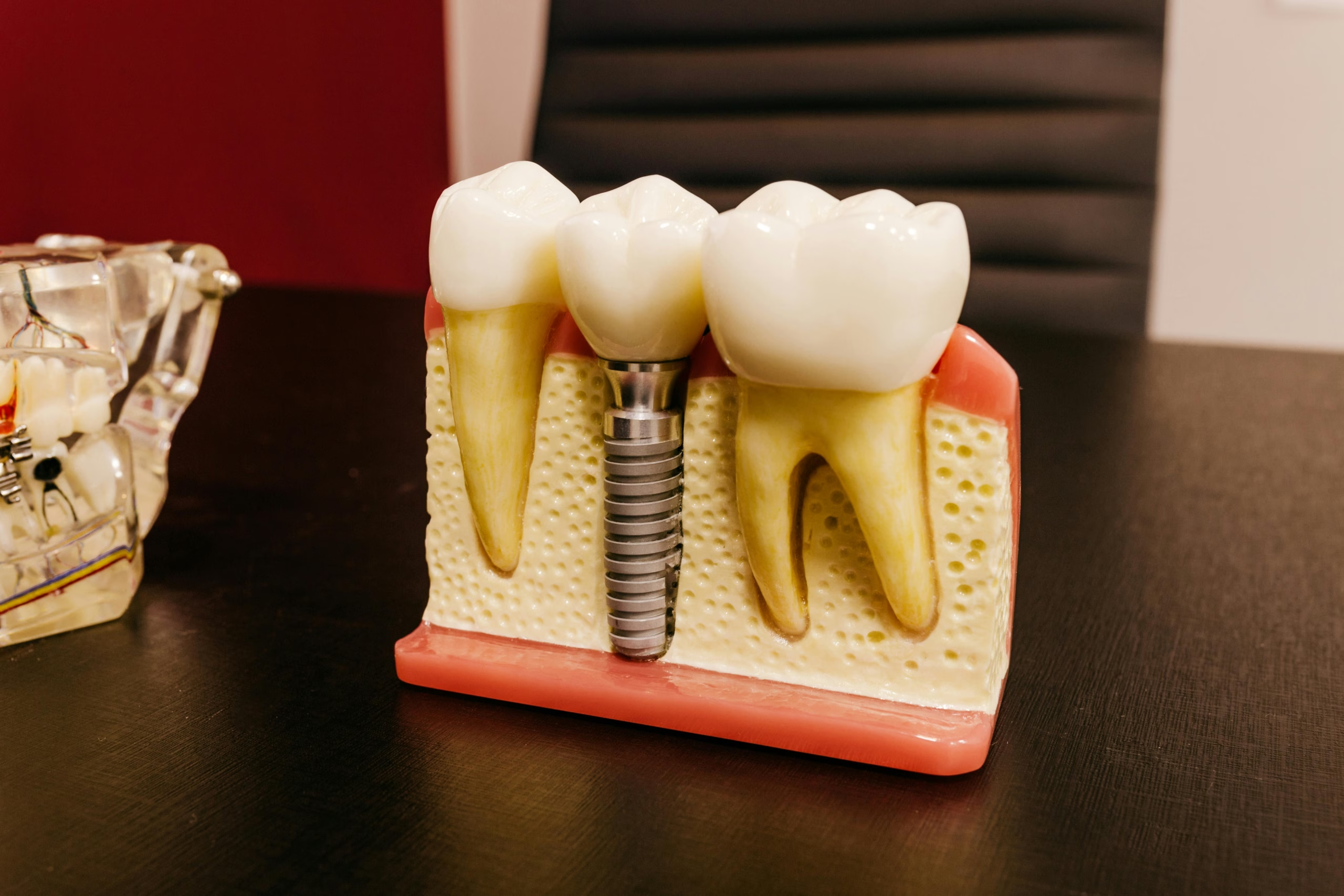
They consist of a titanium post placed into the jawbone, acting as an artificial root that supports a crown, bridge, or full-arch restoration.
Unlike traditional options, implants restore both function and bone structure, making them the gold standard in modern dentistry.
They don’t just replace teeth; they replace the entire system that supports them.
What Are Dental Implants?
A dental implant is a small titanium fixture surgically placed into the jawbone to replace a missing tooth root.
Once integrated with the bone, it provides a stable foundation for a prosthetic tooth, such as a dental crown.
This process, known as osseointegration, allows the implant to function like a natural tooth.
Why Dental Implants Are Needed
Tooth loss affects more than appearance. It leads to bone loss, shifting teeth, and reduced chewing efficiency.
Over time, this can impact facial structure and overall oral health.
Implants prevent these problems by preserving bone and restoring function.
Types of Dental Implants
Dental implants are not one-size-fits-all. Different techniques are used depending on the patient’s needs.
🔹Single Tooth Implant: Used to replace one missing tooth with an individual crown.
🔹Implant-Supported Bridge: Replaces multiple missing teeth without relying on adjacent natural teeth.
🔹Full-Arch Implants: Techniques like All-on-4 allow full restoration using a limited number of implants.
🔹Advanced Implant Options: For complex cases with severe bone loss, specialized approaches such as All-on-4 implants and Zygomatic implants may be used.
👉 These solutions expand treatment possibilities even in challenging situations.
The Dental Implant Procedure
The implant process is done in stages and requires careful planning.
- First, a comprehensive evaluation is performed, often including imaging to assess bone quality.
- If necessary, preparatory procedures such as bone grafting or sinus lift surgery are completed.
- The implant is then surgically placed into the jawbone.
- After placement, a healing period allows the implant to integrate with the bone.
- Finally, a crown or dental prosthesis is attached to complete the restoration.
Precision at every step is essential for long-term success.
Healing and Osseointegration
Healing is one of the most critical phases of implant treatment.
The process of osseointegration allows the implant to fuse with the bone, creating a stable foundation.
This typically takes 3 to 6 months, depending on the patient and treatment complexity.
Dental Implant Prices in the U.S.
Dental implants are among the most expensive dental treatments, but also among the most durable.
Costs vary depending on:
- Number of implants
- Need for additional procedures
- Type of restoration
While the upfront cost is higher, implants often last much longer than alternatives.
🔹Single Tooth Implant Cost
Typical cost:
- $3,000 – $6,000 per tooth
- Can go up to $7,000+ depending on complexity
What’s included:
- Implant (titanium screw)
- Abutment
- Crown
🔹Full Mouth Dental Implants Cost
Typical cost (both arches):
- $50,000 – $100,000+ total
- Lower-end cases: $25,000 – $50,000+
Per arch:
- $20,000 – $55,000 (All-on-4 / All-on-6)
Depends heavily on:
- Number of implants
- Materials (zirconia vs acrylic)
- Need for bone grafts or extractions
🔹Zygomatic Implants (Advanced Cases)
Typical cost:
- $30,000 – $60,000+ (upper arch)
- $80,000+ full mouth in complex cases
Why so expensive?
- Highly specialized procedure
- Used for severe bone loss
- Requires an expert oral surgeon
This is top-tier implant treatment
Quick Dental Implants Price Comparison
Treatment | Cost Range (USA) | Difficulty | Value |
Single implant | $3K – $6K | Low | Standard |
Full mouth implants | $50K – $100K+ | High | Premium |
Zygomatic implants | $30K – $80K+ | Very high | Elite / complex |
What Drives the Price
Costs increase based on:
- Bone grafting/sinus lift (adds $500–$5,000+)
- Sedation/anesthesia
- Surgeon expertise
- Location (NY, LA = higher)
Benefits of Dental Implants
Dental implants offer several major advantages over traditional options.
- They restore full chewing function and feel natural in the mouth.
- They prevent bone loss and help maintain facial structure.
- They do not rely on adjacent teeth, preserving overall oral health.
- They are the closest thing to natural teeth.
Risks and Complications
Although highly successful, implants are not without risks.
These may include infection, implant failure, or complications related to healing.
Risk factors such as smoking, poor oral hygiene, or systemic conditions can affect outcomes.
Proper case selection and maintenance are critical.
Who Is a Good Candidate?
Most healthy adults with sufficient bone are candidates for dental implants.
Patients with bone loss may still qualify with additional procedures such as bone grafting. A thorough evaluation is necessary to determine suitability.
Alternatives to Dental Implants
While implants are the gold standard, other options exist.
Traditional solutions include Dentures and Dental bridges, which can restore function but have limitations. Another option is a dental crown placed over a damaged tooth to strengthen it.
These alternatives may be suitable depending on the clinical situation and budget.
Dental Implants vs Other Options
Compared to removable prosthetics, implants provide superior stability and comfort.
Unlike bridges, they do not require altering adjacent teeth. Plus, their ability to preserve bone gives them a significant long-term advantage.
Clinical Insight
Dental implants represent a major advancement in dentistry because they integrate with the body at a biological level.
Few treatments in medicine combine biomechanics, surgery, and regeneration this effectively.
When to See a Dentist
You should consider evaluation if:
- You have missing teeth
- You struggle with dentures
- You want a long-term solution
Early consultation allows for better planning and outcomes.
Conclusion
Dental implants are the most advanced solution for replacing missing teeth, offering unmatched stability, function, and longevity.
They address not only the visible problem but also the underlying bone structure.
The key points are clear:
- They replace both the tooth and its root
- They preserve bone and facial structure
- They provide long-term, reliable results
When properly planned and maintained, dental implants can last for decades.
Frequently Asked Questions
How long do dental implants last?
They can last decades with proper care.
Are dental implants painful?
The procedure is done under anesthesia, with manageable discomfort afterward.
How long does the process take?
Typically several months, including healing time.
Can implants fail?
Yes, but success rates are very high, around 98%.
Are they worth the cost?
For many patients, their durability and benefits justify the investment.
References
Misch, C. E. (2008). Contemporary implant dentistry (3rd ed.). Mosby Elsevier.
Esposito, M., Grusovin, M. G., Felice, P., & Karatzopoulos, G. (2010). Interventions for replacing missing teeth. Cochrane Database of Systematic Reviews, (3), CD003607.
Brånemark, P. I. (1983). Osseointegration and its experimental background. Journal of Prosthetic Dentistry, 50(3), 399–410.