
All-on-4 Dental Implants: Cost, Procedure, Recovery & Pros and Cons
All-on-4 dental implants are an advanced solution for replacing a full arch of missing teeth using just four strategically placed implants.
This technique allows patients to restore an entire upper or lower set of teeth with fewer implants, reducing treatment time and often avoiding complex procedures like bone grafting.
It is one of the most efficient and popular approaches for full-mouth rehabilitation.
What Are All-on-4 Dental Implants?
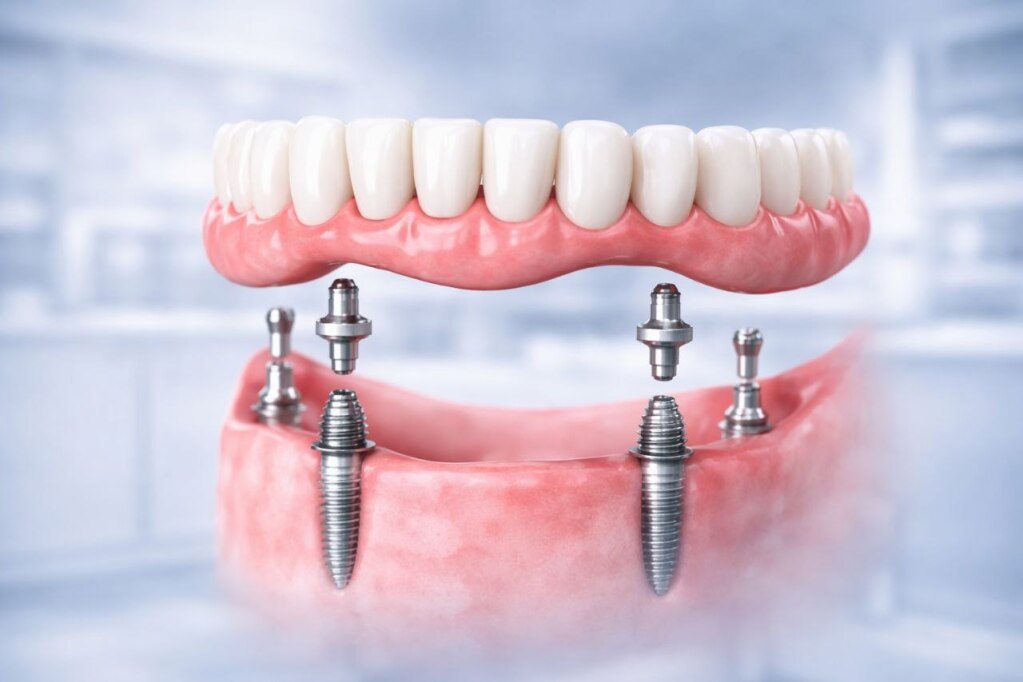
All-on-4 implants are a full-arch restoration method where four implants are placed in specific positions to support a fixed dental prosthesis.
Two implants are placed vertically at the front of the jaw, while the two posterior implants are angled to maximize contact with available bone.
This strategic placement increases stability and often eliminates the need for additional bone augmentation.
Who Is a Candidate for All-on-4 Implants?
This treatment is ideal for patients who:
- Have lost most or all of their teeth
- Have severely damaged or failing teeth
- Experience bone loss in the jaw
- Want a fixed alternative to dentures
Many patients who are not candidates for traditional implants may still qualify for All-on-4 dental implants due to the angled implant design.
The All-on-4 Procedure Step by Step
The process is carefully planned and executed to ensure long-term success:
- First, a detailed evaluation is performed, including imaging to assess bone structure.
- Any remaining damaged teeth may be removed during the same appointment.
- The four implants are then placed into the jawbone in strategic positions.
- In many cases, a temporary fixed prosthesis is attached on the same day.
- After healing and integration, a permanent prosthesis is placed.
This “same-day teeth” concept is one of the biggest advantages of this technique.
Recovery and Healing Time
Recovery after All-on-4 implants is generally faster than traditional full-mouth implant procedures.
- Patients may experience swelling, discomfort, and dietary restrictions for the first few days.
- Most return to normal activities within a short period.
- Full healing and integration typically occur over several months.
Following post-operative instructions is essential to prevent complications.
Cost of All-on-4 Dental Implants
In the United States, All-on-4 dental implants typically cost:
- $20,000 – $40,000 per arch
- $40,000 – $80,000+ for full mouth
The final cost depends on factors such as materials, provider expertise, and case complexity.
While expensive, this solution is often more cost-effective than placing individual implants for each tooth.
Benefits of All-on-4 Implants
This technique offers several key advantages:
- It allows full-arch restoration with fewer implants, reducing surgical complexity.
- It often eliminates the need for bone grafting, even in patients with bone loss.
- It provides a fixed, stable solution that feels more natural than removable dentures.
- It also offers faster treatment and immediate functional improvement.
Pros and Cons
✅ Advantages:
- Fewer implants required
- Faster treatment timeline
- Fixed, non-removable solution
- High success rate
❌ Disadvantages:
- Not suitable for all cases
- Requires surgery
- Higher upfront cost
- Maintenance is still necessary
Understanding both sides is essential before making a decision.
All-on-4 Implants vs Dentures
Traditional dentures rest on the gums and can become unstable over time.
All-on-4 dental implants provide a fixed solution that does not shift or move.
They improve chewing efficiency and eliminate many of the limitations associated with removable prosthetics.
For many patients, this represents a major upgrade in quality of life.
Risks and Complications
Although highly successful, All-on-4 implants carry some risks. These may include:
- Infection
- Implant failure
- Complications related to healing.
Proper case selection and good oral hygiene are critical for long-term success.
How Long Do All-on-4 Implants Last?
With proper care, All-on-4 dental implants can last for decades.
The implants themselves are designed to be long-lasting, while the prosthesis may need maintenance or replacement over time.
Clinical Insight
The success of All-on-4 implants is based on biomechanics and strategic implant placement.
By maximizing available bone, this technique allows treatment even in cases that would otherwise require extensive surgery.
Conclusion
All-on-4 dental implants are a highly effective solution for full-arch tooth replacement, offering a balance of efficiency, stability, and long-term performance.
They provide a modern alternative to traditional dentures and can significantly improve function and quality of life.
The key points are clear:
- They replace a full arch using only four implants
- They often avoid the need for bone grafting
- They provide a fixed, stable solution
👉 For many patients, they represent the most practical path to full-mouth restoration.
Frequently Asked Questions
Are All-on-4 implants permanent?
They are designed to be long-lasting, though maintenance may be required.
Is the procedure painful?
No, it is performed under anesthesia, with manageable discomfort afterward.
Can I eat normally after treatment?
A soft diet is recommended initially, followed by gradual return to normal eating.
Are All-on-4 implants better than dentures?
They provide greater stability and function for most patients.
How long does the procedure take?
Surgery is usually completed in one day, with full treatment over several months.
References
Malo, P., de Araújo Nobre, M., Lopes, A., & Moss, S. M. (2011). All-on-4 immediate-function concept. Clinical Implant Dentistry and Related Research, 13(1), 1–9.
Esposito, M., Grusovin, M. G., Felice, P., & Karatzopoulos, G. (2010). Interventions for replacing missing teeth. Cochrane Database of Systematic Reviews, (3), CD003607.
Misch, C. E. (2008). Contemporary implant dentistry (3rd ed.). Mosby Elsevier.